
San Diego e-moto accidents are getting new attention in 2026. The issue is not simply that more people are riding electric two-wheelers. Officials are now questioning whether some powerful vehicles sold to families as “e-bikes” are actually electric motorcycles under California law.
On September 15, 2026, the San Diego County Board of Supervisors directed county attorneys to investigate companies that may be marketing high-powered electric motorcycles as ordinary e-bikes. County officials raised concerns about vehicles capable of reaching speeds far beyond the legal limits for California electric bicycles.
This distinction can matter after an injury. A rider may believe they were operating a normal e-bike when the vehicle’s motor power, throttle capability, speed, or design places it in another legal category. That can affect safety rules, licensing questions, insurance issues, and the evidence needed after a crash.
For injured riders, parents, pedestrians, and drivers, the most important step is to identify the vehicle accurately. Do not rely only on the product name or what a salesperson called it.
Why San Diego Is Scrutinizing High-Powered E-Motos in 2026
E-bikes have become common throughout San Diego County. Riders use them near schools, beaches, residential neighborhoods, shopping districts, and bike paths. Many families choose them because they appear easier to use than motorcycles and do not normally require a driver’s license or registration.
That assumption only works when the vehicle actually meets California’s legal definition of an electric bicycle.
County officials say some products sold as e-bikes may reach 40, 50, or even 60 mph. Vehicles with that level of performance can create very different risks from a standard Class 1 or Class 2 e-bike.
If you need the broader injury-claim basics first, read our guide to San Diego e-bike injury claims in 2026.
California Law Separates Legal E-Bikes From Other Motor Vehicles
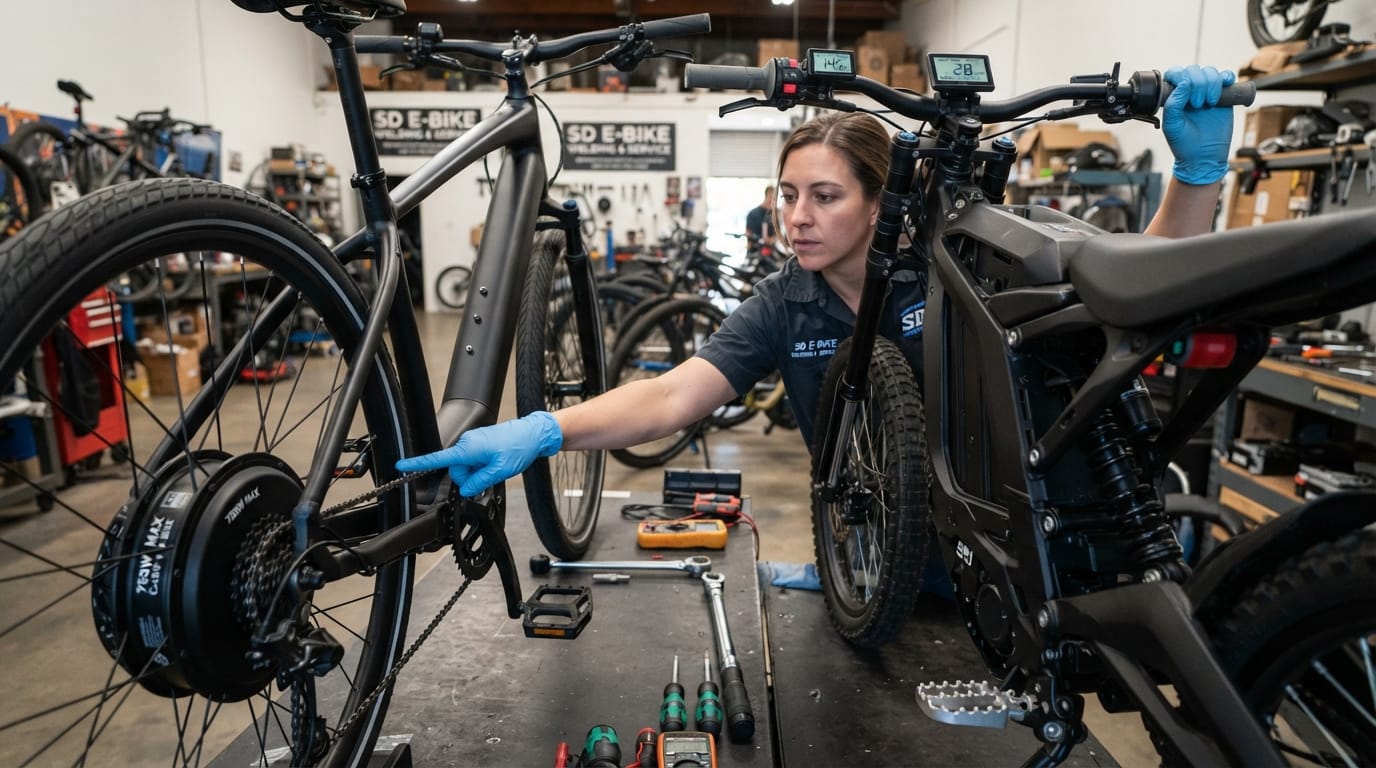
California uses three main e-bike classes. A legal electric bicycle must have operable pedals and an electric motor within the state’s power limits.
A Class 1 e-bike provides assistance while the rider pedals and stops assisting at 20 mph. A Class 2 e-bike may use a throttle, but motor assistance must stop at 20 mph. A Class 3 e-bike uses pedal assistance and stops assisting at 28 mph.
California also limits the motor power of an electric bicycle. A vehicle that exceeds the applicable power or assisted-speed limits may no longer qualify as an e-bike.
Speed, Motor Power, and Pedals Can Change the Vehicle Classification
A fast electric vehicle does not become a legal e-bike simply because it has two wheels or resembles a bicycle.
California authorities have warned that a vehicle may fall outside the e-bike definition if it provides pedal assistance beyond 28 mph, provides throttle assistance beyond 20 mph, exceeds 750 watts, or lacks operable pedals.
That distinction can trigger different rules. Depending on the vehicle, motorcycle or moped requirements may become relevant. Those rules can involve licenses, registration, helmets, roadway use, and other restrictions.
Parents should pay particular attention when buying a high-powered model for a teenager. A product listing that uses terms such as “e-bike” or “electric bicycle” does not necessarily establish its legal classification.
A Product Label Does Not Tell the Entire Story
California requires e-bikes sold in the state to carry labeling that identifies the classification, assisted speed, and motor wattage. However, buyers should still compare those claims with the vehicle’s actual specifications.
Check the motor rating, throttle operation, maximum assisted speed, pedals, model number, owner’s manual, and manufacturer specifications. Save screenshots of the original product listing when possible.
This evidence can become important after an accident. An online listing may later change. A seller may remove a product or revise its description after regulators raise concerns.
The California Attorney General issued a 2026 consumer alert reminding retailers that they may only market vehicles as e-bikes when those products fall within California’s legal classes. You can review the California Attorney General’s official e-bike safety guidance.
Liability After an E-Moto Injury Can Involve More Than the Rider
Most two-wheel vehicle crashes still require a basic negligence investigation. Investigators may look at speed, right of way, traffic signals, visibility, distraction, helmet use, and the actions of every person involved.
However, an improperly marketed e-moto can add another layer.
Suppose parents buy a vehicle because a retailer describes it as a legal e-bike for neighborhood use. Later, evidence shows that the vehicle can exceed California’s e-bike limits and operates more like an electric motorcycle. If a crash occurs, investigators may need to examine what the manufacturer and retailer represented at the time of sale.
That does not automatically make a seller or manufacturer liable for every accident. The facts still matter. Investigators would need to examine the product, marketing, warnings, modifications, rider conduct, and how the crash occurred.
Retailer or Manufacturer Conduct May Become Part of the Investigation
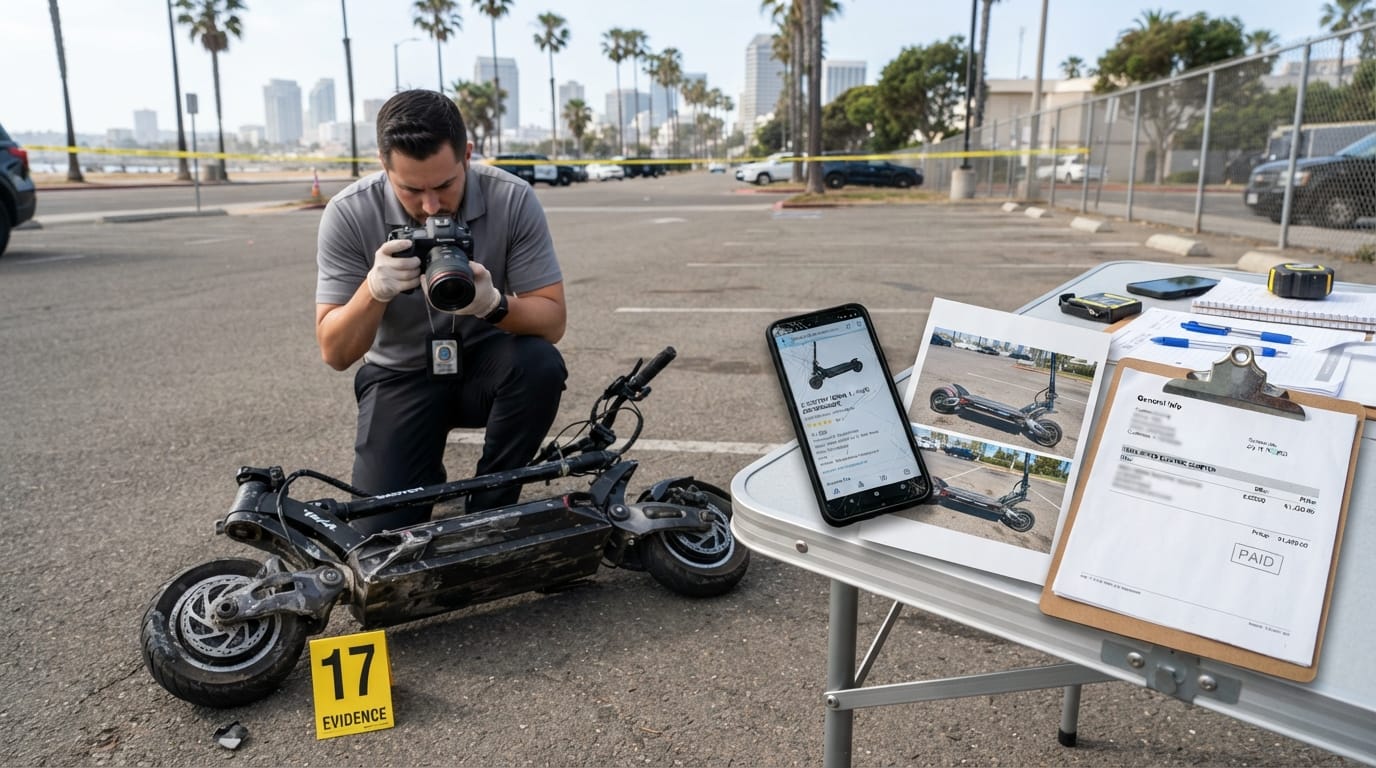
An injury investigation may include the original advertisement, sales receipt, product label, owner’s manual, packaging, warnings, website screenshots, and communications with the seller.
These records can help answer several questions. How did the seller describe the vehicle? Did the specifications match that description? Did the manufacturer warn buyers about licensing or roadway restrictions? Did anyone modify the vehicle after purchase?
Product condition matters too. A crash involving excessive speed differs from one caused by a brake failure, battery problem, steering defect, or structural failure.
If the incident involves a battery fire rather than a roadway collision, see our guide to lithium-ion battery fire injuries involving e-bikes and e-scooters.
What to Do After San Diego E-Moto Accidents
After serious San Diego e-moto accidents, medical care comes first. High-powered electric two-wheelers can produce severe injuries because riders have little physical protection.
Common injuries may include fractures, head injuries, facial trauma, road rash, shoulder injuries, knee damage, and spinal injuries. A rider should receive appropriate evaluation after a hard impact, especially when symptoms include confusion, severe headache, vomiting, numbness, weakness, or loss of consciousness.
Next, preserve the vehicle. Avoid repairing, modifying, selling, or disposing of it while important questions remain about its classification or performance.
Preserve the Vehicle, Product Listing, and Digital Evidence
Photograph the e-moto from several angles. Capture labels, motor markings, controls, pedals, tires, damage, battery information, and the display.
Save the owner’s manual and purchase receipt. Take screenshots of the manufacturer’s and retailer’s product pages. Include any language about speed, wattage, rider age, street legality, or vehicle classification.
If an app connects to the vehicle, preserve available settings and ride history. Do not reset the system merely to troubleshoot the problem after a serious crash.
Also document the accident scene. Photograph traffic signals, signs, bike lanes, skid marks, debris, lighting, road conditions, and nearby cameras.
Witness information can help establish what happened before impact. A driver, pedestrian, store employee, or another rider may have noticed the speed or movement of the vehicle before the crash.
For incidents involving younger riders, our article on teen e-bike accidents in San Diego explains additional issues that families may face.
Vehicle Classification Can Also Affect Insurance Questions
Insurance can become complicated when a vehicle does not qualify as the product the owner believed they purchased.
A homeowners, renters, auto, motorcycle, or specialty policy may treat electric bicycles and motor vehicles differently. Policy definitions, exclusions, vehicle ownership, and the circumstances of the crash can affect available coverage.
Do not assume that a policy covers an e-moto merely because someone called it an e-bike. At the same time, do not assume that no coverage exists. Review the actual policy language and identify every potentially relevant policy.
Classification may also matter when another person caused the collision. The claim may involve the other driver’s liability insurance, the rider’s available coverage, or other sources depending on the facts.
The new San Diego County investigation makes this issue especially important in 2026. Officials are not simply debating how teenagers ride legal e-bikes. They are examining whether companies are selling vehicles that fall outside the e-bike category while marketing them as if they belong inside it.
That distinction can change an injury investigation. A vehicle’s actual motor power, assisted speed, throttle behavior, pedals, warnings, and sales materials may all become evidence.
For families, the practical lesson is straightforward. Before buying an electric two-wheeler, verify what it actually is. After a crash, preserve the vehicle and every record connected with the purchase.
San Diego e-moto accidents can involve rider behavior, traffic-law questions, product marketing, vehicle classification, insurance, or several of those issues at once. Avoid reducing the investigation to a single assumption.
The label on the sales page may say “e-bike.” California law may say something different.
This article provides general educational information and is not legal advice. Vehicle classification, liability, insurance coverage, and product-related claims depend on the specific vehicle, accident, policy, and facts involved.