
Dangerous road conditions in San Diego can contribute to serious accidents involving drivers, pedestrians, cyclists, and motorcyclists. While many personal injury claims focus on negligent drivers, some collisions raise another question: could the design or condition of the roadway have contributed to the crash?
In 2026, this issue remains relevant because San Diego continues to evaluate traffic safety through its Vision Zero initiatives. The city uses collision data to identify locations where roadway improvements may reduce deaths and serious injuries. Regional transportation planners also study dangerous corridors, intersection designs, speeding, and risks faced by vulnerable road users.
For injured people, these efforts highlight an important distinction. A location may have a documented history of crashes, but that does not automatically establish that the government is legally responsible for an individual accident. California law imposes specific requirements on claims involving dangerous public property.
A successful investigation may require photographs, maintenance records, traffic studies, witness statements, engineering evidence, and proof connecting the alleged roadway defect to the injury.
This guide explains how dangerous roadway claims work, what evidence may matter, and why government claim deadlines should receive immediate attention after a serious accident.
How Dangerous Road Conditions Can Contribute to San Diego Injury Accidents
Roadway safety depends on more than traffic signals and posted speed limits. Lane configuration, surface conditions, visibility, drainage, intersection geometry, and pedestrian facilities can all influence how road users encounter potential hazards.
In San Diego, busy commercial corridors, neighborhood intersections, freeway approaches, school zones, and coastal routes present different traffic challenges. A condition that poses little difficulty during daylight may become dangerous after dark or during heavy rainfall.
Common concerns include deteriorated pavement, inadequate warnings, obscured signs, confusing lane transitions, malfunctioning traffic signals, and drainage problems that leave water across travel lanes.
However, not every pothole, collision, or missing safety feature proves negligence. Investigators must determine whether a specific condition created a substantial risk of injury when the property was used with reasonably foreseeable care.
Roadway defects that may become relevant to injury claims
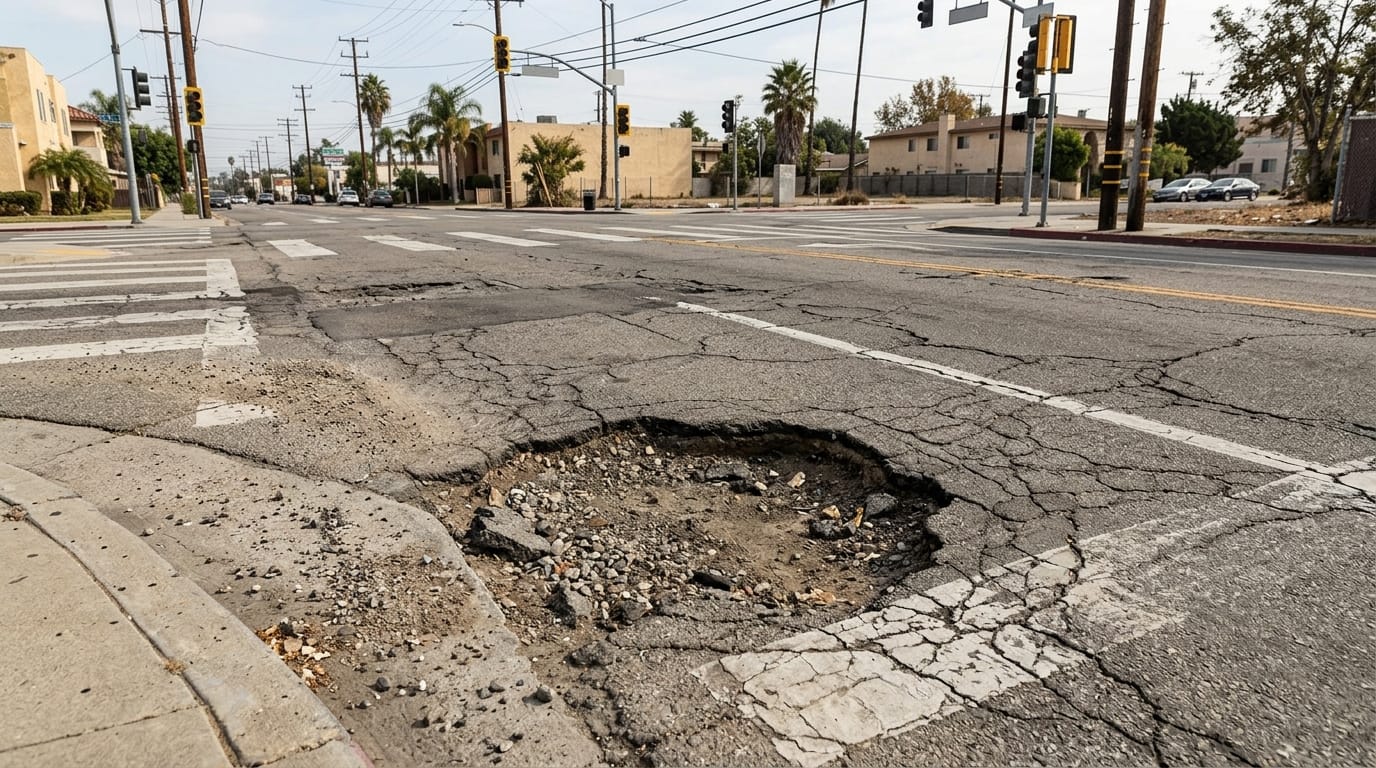
Several roadway characteristics may require investigation after a collision. Significant pavement defects can cause drivers or cyclists to lose control. Poor drainage may create standing water, while inadequate visibility near a crossing can reduce reaction time.
Intersection design can also matter. A confusing turn lane, obstructed sightline, or unclear transition between traffic movements may contribute to a dangerous situation.
These issues must be evaluated in context. A photograph showing uneven pavement does not, by itself, establish that the defect caused an accident. Evidence should connect the condition to the vehicle’s movement, the injured person’s actions, and the sequence leading to impact.
Potholes, uneven pavement, and drainage problems
Road-surface defects can affect motorcycles, bicycles, and passenger vehicles differently. A pothole that causes minor discomfort for a larger vehicle may destabilize a cyclist or motorcycle rider.
Uneven pavement, raised edges, broken asphalt, and accumulated debris can create additional risks. During rain, standing water may conceal defects or contribute to a loss of traction.
Following an accident, investigators should document the defect’s approximate dimensions, location, visibility, surrounding warnings, and relationship to the vehicle’s path.
Maintenance records and earlier complaints may also help establish how long the condition existed and whether responsible officials knew or reasonably should have known about it.
Missing signs and poor intersection visibility
Some accidents involve the driver’s inability to see a pedestrian, traffic signal, or approaching vehicle until it is too late. Parked vehicles, vegetation, roadway geometry, and poorly positioned warnings may all influence visibility.
California’s daylighting requirements have increased attention to the space immediately surrounding intersections and crosswalks.
Our existing article on San Diego daylighting law accident claims explains how blocked sightlines and parking restrictions may affect a pedestrian injury investigation.
Although a visibility problem may support further investigation, determining responsibility requires evaluating driver behavior, applicable traffic rules, and whether the alleged roadway condition was legally dangerous.
How Vision Zero data may support an investigation
San Diego’s Vision Zero program focuses on reducing traffic deaths and serious injuries. Its data resources include collision information derived from police reports, allowing users to examine patterns involving different transportation modes and geographic areas.
Regional transportation agency SANDAG also identifies roadways where serious crashes are concentrated. Its Vision Zero Action Plan states that approximately 6% of the regional network accounts for 54% of fatal or serious injury crashes.
These findings can help researchers understand which locations deserve safety improvements. They may also provide useful background during a roadway investigation.
However, crash concentration does not automatically prove legal liability. An injured person still needs evidence concerning the particular accident, the alleged dangerous condition, and the requirements of California law.
Why earlier crash reports and complaints matter
Prior crashes may help investigators determine whether a hazardous condition was recurring or known. For example, repeated collisions involving similar movements at an intersection could justify reviewing roadway design and historical complaints.
Relevant evidence may include collision reports, traffic studies, maintenance requests, inspection records, and communications concerning proposed improvements.
These materials require careful interpretation. Crashes can occur for different reasons, and reports may reflect driver behavior rather than a defect in public property.
When reviewing official records, investigators should compare the earlier incidents with the circumstances of the current injury. Similar locations alone may not establish a meaningful connection.
When Can a Public Entity Be Responsible for a Dangerous Roadway Accident?
Claims involving government-controlled roads differ from ordinary negligence claims against private drivers. California Government Code Section 835 establishes circumstances under which a public entity may be liable for an injury caused by a dangerous condition of public property.
Generally, the claimant must establish that the property was in a dangerous condition at the time of injury, that the condition proximately caused the injury, and that the condition created a reasonably foreseeable risk of the type of injury that occurred.
Additional statutory requirements concern whether the dangerous condition was created by a public employee’s negligent or wrongful act within the scope of employment or whether the public entity had actual or constructive notice of the condition sufficiently in advance to take protective measures.
Other legal defenses may apply, including design immunity under Government Code Section 830.6 in qualifying circumstances. This makes public-roadway litigation legally complex.
Evidence, deadlines, and steps after a serious crash
When an injured person suspects a roadway defect, preserving evidence should begin as early as safely possible. Road conditions may change after the accident. Maintenance crews may repair damaged pavement, remove debris, replace signage, or modify traffic controls.
Photographs and video should capture the scene from multiple perspectives. Include surrounding landmarks, traffic signs, pavement markings, lighting conditions, drainage structures, and the direction of travel.
Medical records are equally important. They establish the nature of the injuries and may help document their relationship to the collision.
Our guide to San Diego hit-and-run pedestrian injury claims explains why early reporting, witness information, and evidence preservation are critical when important accident details may disappear.
Government claim deadlines can be much shorter
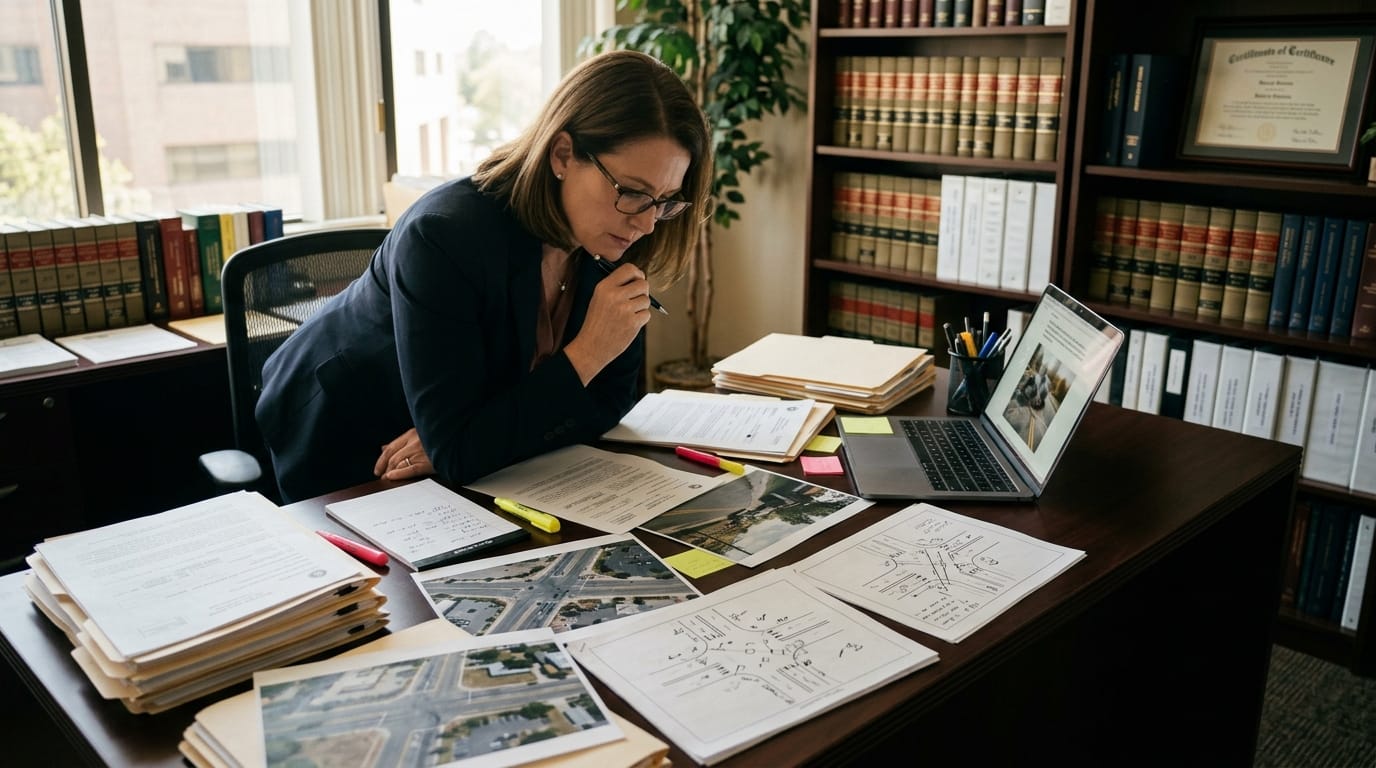
California generally provides a two-year statute of limitations for many personal injury lawsuits under Code of Civil Procedure Section 335.1. However, claims against public entities commonly require a separate administrative claim much earlier.
Under Government Code Section 911.2, a claim relating to personal injury generally must be presented to the appropriate public entity no later than six months after the cause of action accrues.
That administrative process is not the same as immediately filing a lawsuit. Additional rules govern claim rejection, late applications, and deadlines for court proceedings.
Determining the correct public entity is also important. A roadway may be maintained by a city, county, state agency, or another public authority. Assuming that every road within San Diego belongs to the City of San Diego can create costly mistakes.
Potential government claims should be reviewed promptly because waiting for medical treatment to finish may cause a critical deadline to pass.
California law also recognizes comparative fault. A driver may have been speeding or distracted while a dangerous roadway condition contributed to the accident. Investigators must distinguish each potential cause instead of assuming that only one party can be responsible.
For a related discussion of how technology and driver behavior influence accident investigations, review our article about AI insurance claim reviews in San Diego.
In addition, traffic-safety researchers can consult the official SANDAG Vision Zero Action Plan for information about regional roadway safety priorities and high-injury networks.
After an accident, injured people should seek appropriate medical care, report the collision, preserve available evidence, and identify whether public property may have played a role.
They should also avoid assuming that a government agency’s decision to improve a roadway necessarily proves that the previous design was unlawful. Evidence of subsequent repairs or safety improvements may be subject to important legal restrictions.
Similarly, the existence of an accident report does not guarantee that a roadway claim will succeed. The claim depends on statutory requirements, causation, available evidence, and applicable defenses.
Dangerous road conditions in San Diego remain an important public-safety concern in 2026. Vision Zero data helps identify transportation risks, but each personal injury case requires an individual legal analysis.
When roadway defects, blocked visibility, poor drainage, or public maintenance issues may have contributed to serious injuries, obtaining timely professional guidance can help protect important evidence and legal rights.
Disclaimer: This article is intended for general educational purposes and does not constitute legal advice. Government liability, procedural deadlines, and available remedies depend on the facts and applicable California law.